
Claude Opus 4.8: Code Faster, Think Bigger
Claude Opus 4.8 unlocks faster coding, longer context, and stronger agent workflows for serious enterprise work.
29 mag 2026 (Aggiornato il 29 mag 2026) - Scritto da Lorenzo Pellegrini
Anthropic and Claude are trademarks of Anthropic PBC; this article is an independent editorial piece.
Smetti di strapagare i corsi tech: Accedi gratis a lezioni avanzate
I corsi avanzati di programmazione e sviluppo IA costano spesso migliaia di euro. Accedi a moduli e-learning strutturati direttamente dalla tua dashboard.
Claude Opus 4.8: What Anthropic’s Latest Frontier Model Means for Coding, Agents, and Enterprise Work
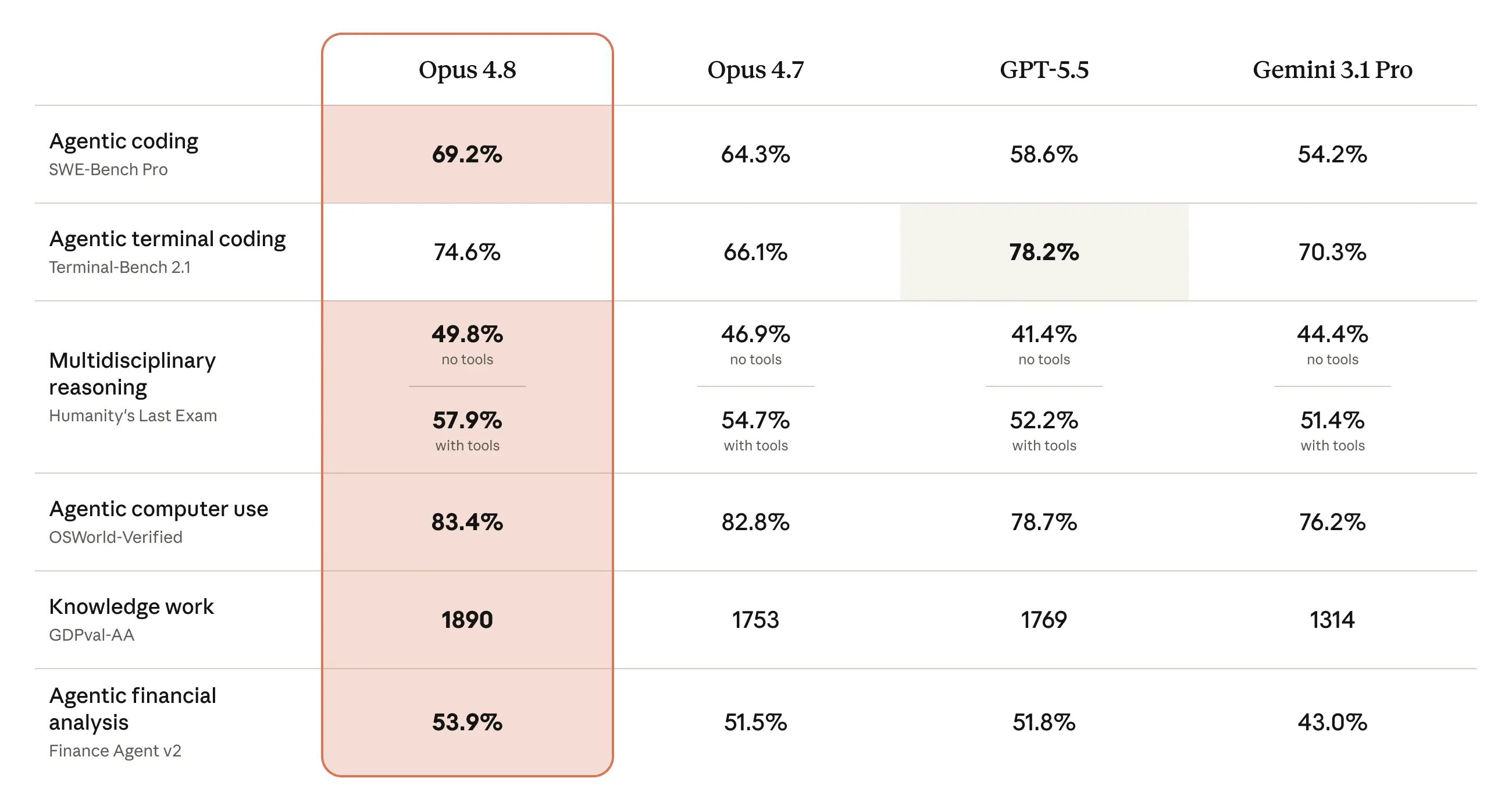
Claude Opus 4.8 is Anthropic’s most capable generally available model to date, built for complex reasoning, long-horizon agentic coding, and high-autonomy professional work. It introduces a larger default context window, faster output in a new research-preview fast mode, lower cacheable prompt requirements, and targeted improvements in coding performance and reasoning reliability.
What Claude Opus 4.8 Is
Anthropic positions Claude Opus 4.8 as a premium model for tasks where performance matters most, especially professional software engineering, complex workflows, and enterprise use cases. It is available to Claude Pro, Max, Team, and Enterprise users, and also through the Claude Platform for developers. The model is described by Anthropic as its most capable generally available model so far.
On the API side, Claude Opus 4.8 supports a 1M token context window by default on the Claude API, Amazon Bedrock, and Vertex AI, with 200k on Microsoft Foundry. It also supports up to 128k max output tokens, adaptive thinking, and the same tools and platform features available in Claude Opus 4.7.
Key Improvements in Claude Opus 4.8
- Better long-horizon agentic coding, with improved long-context handling, fewer compactions, and better compaction recovery.
- More reliable reasoning effort calibration, with more consistent behavior across effort levels in a range of domains.
- Fast mode in research preview on the Claude API, designed to deliver up to 2.5x higher output tokens per second at premium pricing.
- Lower cacheable prompt threshold, with the minimum cacheable prompt length reduced to 1,024 tokens.
- Messages API flexibility, including support for `role: "system"` messages immediately after a user turn in the messages array, subject to placement rules.
Why the 1M Token Context Window Matters
The default 1M token context window is one of the most important practical upgrades in Claude Opus 4.8. For users working with long documents, large codebases, or multi-step agent workflows, a larger context window makes it easier to keep relevant information in memory during a session.
In practice, that means fewer interruptions caused by context limits, better continuity in coding sessions, and more room for high-complexity tasks that require the model to track many dependencies at once.
Claude Opus 4.8 for Coding and Agentic Workflows
Anthropic highlights Claude Opus 4.8 as especially strong for professional software engineering and agentic coding. The company says the model is designed to handle longer tasks with fewer compactions, which can help when a workflow spans many steps or needs repeated tool use.
For developers, this makes Opus 4.8 a strong fit for:
- Large codebase analysis
- Multi-file refactoring
- Long-running coding agents
- Tool-using workflows with many steps
- Enterprise tasks that require careful reasoning and consistency
Availability Across Platforms
Claude Opus 4.8 is available in the Claude app for Pro, Max, Team, and Enterprise users. For developers, it is available on the Claude Platform and through major cloud platforms including Amazon Web Services, Google Cloud, and Microsoft Foundry.
AWS also announced support for Claude Opus 4.8 on Amazon Bedrock and the Claude Platform on AWS, emphasizing enterprise security, regional data residency, and scaling within existing AWS environments. AWS notes that the model is available in several regions, including the US East, Tokyo, Ireland, and Stockholm regions.
Pricing and Positioning
Anthropic describes Claude Opus 4.8 as a premium model that is intended for work where top-tier performance is more important than cost efficiency. In that sense, it sits at the high end of the Claude family and is aimed at users who need frontier capability for difficult tasks rather than everyday lightweight use.
The release also continues Anthropic’s broader model strategy of offering Claude models across the spectrum of speed, price, and performance, with Opus positioned as the most capable option.
What Makes This Release Important
Claude Opus 4.8 is important because it combines product-level usability improvements with platform-level capability gains. The larger context window, improved agentic coding behavior, and lower caching threshold all point toward better support for real-world, long-running workloads.
For general users, that means a more capable assistant for difficult writing, analysis, and planning tasks. For developers and enterprises, it means a stronger model for building AI systems that need persistence, context retention, and reliable execution across long sessions.
Conclusion
Claude Opus 4.8 is Anthropic’s most capable generally available model, and its upgrades are focused on the kinds of tasks that matter most in advanced AI use, especially coding, reasoning, and agentic workflows. With broader platform availability, a larger default context window, and targeted performance improvements, it is clearly aimed at users who need a high-end model for demanding work.
The real shift is not that Claude Opus 4.8 writes better code, but that it moves the bottleneck from generation to governance: once a model can sustain long, tool-rich workflows, the decisive advantage becomes how well a team can supervise, constrain, and verify its output. In that sense, the 1M context window is less a productivity feature than an operating model change for software and enterprise work.
Where can I access Claude Opus 4.8?